KAUST claims 33.7% efficiency for perovskite/silicon tandem solar cell
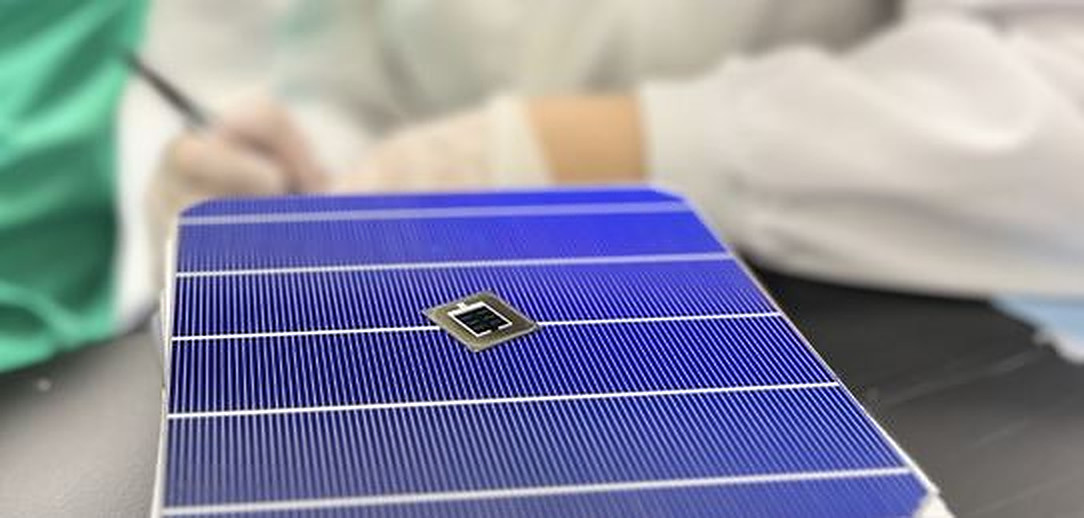
Scientists led by Saudi Arabia’s KAUST have achieved a power conversion efficiency of 33.7% for a perovskite-silicon solar cell. KAUST Professor Erkan Aydin made the announcement on its LinkedIn account.
“In two months’ time, we’ve set a new world record for perovskite/silicon tandem solar cells—again! With our latest update, perovskite/silicon tandem solar cells have reached impressive 33.7% certified power conversion efficiency, surpassing our previous milestone of 33.2%. We hope that our new achievement will contribute to accelerating the green energy transition,” he stated.
The European Solar Test Installation (ESTI) has certified the result.
The 1 cm2 cell also achieved an open-circuit voltage of 1.974 V, a short-circuit current density of 20.99 mA/cm2, and a fill factor of 81.3%.
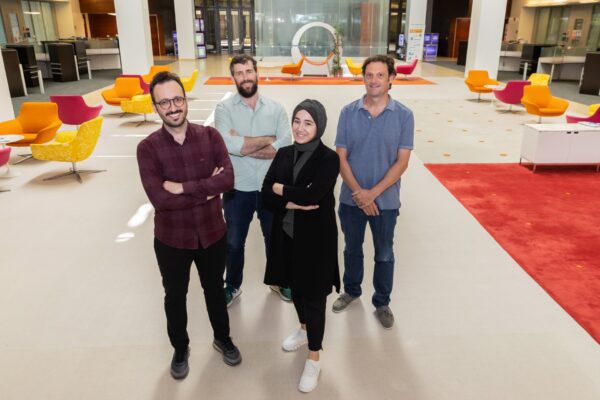
Image: KAUST
In January, KAUST announced a power conversion efficiency of 28.1% for a perovskite-silicon tandem solar cell based on textured silicon wafers. In August 2022, it claimed a 26.2% efficiency for a monolithic perovskite-silicon tandem photovoltaic device.
In December 2021, KAUST researchers achieved a power conversion efficiency of 28.2% for a tandem solar cell with an area of around 1 cm2, based on an n-i-p perovskite stacked on top of a silicon heterojunction.
The same research group recently announced an inverted perovskite-silicon tandem solar cell with a 1 nm interlayer based on magnesium fluoride (MgFx) placed between the perovskite layer and the hole transport layer (HTL), in order to reduce voltage losses.
This content is protected by copyright and may not be reused. If you want to cooperate with us and would like to reuse some of our content, please contact: [email protected].

Please login to comment

[…] international group of scientists led by Saudi Arabia’s King Abdullah University of Science and Technology (KAUST) has developed an inverted perovskite solar cell incorporating low-dimensional perovskite […]
[…] international group of scientists led by Saudi Arabia’s King Abdullah University of Science and Technology (KAUST) has developed an inverted perovskite solar cell incorporating low-dimensional perovskite […]
[…] international group of scientists led by Saudi Arabia’s King Abdullah University of Science and Technology (KAUST) has developed an inverted perovskite solar cell incorporating low-dimensional […]
[…] this approach, researchers abroad have recently achieved a tandem solar cell efficiency of 33.7%. They did this by building a thin solar cell out of a material called perovskite directly on top of […]
[…] this approach, researchers overseas recently achieved a tandem solar cell efficiency of 33.7%. They did this by building a thin solar cell with a […]
[…] this approach, researchers overseas recently achieved a tandem solar cell efficiency of 33.7%. They did this by building a thin solar cell with a […]
[…] this approach, researchers overseas recently achieved a tandem solar cell efficiency of 33.7%. They did this by building a thin solar cell with a […]
[…] at King Abdullah University of Science and Technology in Saudi Arabia, claims his team has achieved 33.7 percent efficiency in a yet unpublished tandem cell test run earlier this year. LONGi, a Chinese company that produces a majority of the world’s solar panels, […]
[…] рекорд был достигнут Университетом науки и технологий короля Абдаллы (KAUST) Саудовской Аравии, который в июне достиг […]
[…] auf mittlerweile 26,3 Prozent verdoppelt. Im Tandemverbund mit einer Siliziumzelle erreichten erste Prototypen im Labor schon 33,7 Prozent. Parallel zeigt die Forschung an Perowskiten für Solarzellen – und auch anderen Anwendungen wie […]
[…] this approach, researchers overseas recently achieved a tandem solar cell efficiency of 33.7%. They did this by building a thin solar cell with a […]
[…] this approach, researchers overseas recently achieved a tandem solar cell efficiency of 33.7%. They did this by building a thin solar cell with a […]
[…] electricity – than if just one material is used (such as silicon alone).Using this approach, researchers overseas recently achieved a tandem solar cell efficiency of 33.7%. They did this by building a thin solar cell with a material called perovskite directly on top of a […]
[…] this approach, researchers overseas recently achieved a tandem solar cell efficiency of 33.7%. They did this by building a thin solar cell with a […]
[…] this approach, researchers overseas recently achieved a tandem solar cell efficiency of 33.7%. They did this by building a thin solar cell with a […]
[…] this approach, researchers overseas recently achieved a tandem solar cell efficiency of 33.7%. They did this by building a thin solar cell with a […]
[…] this approach, researchers abroad recently achieved Tandem solar cell efficiency of 33.7%. They This was done by Making a thin solar cell from a […]
[…] researchers use this approach recent achievements The tandem solar cell efficiency is 33.7%.them This is done by with something called perovskite […]
[…] this approach, researchers overseas recently achieved a tandem solar cell efficiency of 33.7%. They did this by building a thin solar cell with a […]
[…] the groups with the highest power conversion rates. In May, a team of engineers in Saudi Arabia announced that they’d achieved an efficiency rate of 33.7% using their own perovskite-silicon tandem cells. […]
[…] at King Abdullah University of Science and Technology in Saudi Arabia, claims his team has achieved 33.7 percent efficiency in a yet unpublished tandem cell test run earlier this year. LONGi, a Chinese company that produces a majority of the world’s solar panels, […]
[…] at King Abdullah University of Science and Technology in Saudi Arabia, claims his team has achieved 33.7 percent efficiency in a yet unpublished tandem cell test run earlier this year. LONGi, a Chinese company that produces a majority of the world’s solar panels, […]
[…] aan de King Abdullah University of Science and Technology in Saoedi-Arabië, beweert dat zijn team behaalde een efficiëntie van 33,7 procent in een nog niet gepubliceerde testrun met tandemcellen eerder dit jaar. LONGi, een Chinees bedrijf dat een meerderheid van de zonnepanelen ter wereld […]
[…] de la Universidad de Ciencia y Tecnología Rey Abdullah en Arabia Saudita, afirma que su equipo ha logró una eficiencia del 33,7 por ciento en una prueba de celda en tándem aún no publicada a principios de este año. LONGi, una empresa china que produce la mayoría de los paneles solares […]
[…] at King Abdullah University of Science and Technology in Saudi Arabia, claims his team has achieved 33.7 percent efficiency in a yet unpublished tandem cell test run earlier this year. LONGi, a Chinese company that produces a majority of the world’s solar panels, […]
[…] at King Abdullah University of Science and Technology in Saudi Arabia, claims his team has achieved 33.7 percent efficiency in a yet unpublished tandem cell test run earlier this year. LONGi, a Chinese company that produces a majority of the world’s solar panels, […]
[…] at King Abdullah University of Science and Technology in Saudi Arabia, claims his team has achieved 33.7 percent efficiency in a yet unpublished tandem cell test run earlier this year. LONGi, a Chinese company that produces a majority of the world’s solar panels, […]
[…] at King Abdullah University of Science and Technology in Saudi Arabia, claims his team has achieved 33.7 percent efficiency in a yet unpublished tandem cell test run earlier this year. LONGi, a Chinese company that produces a majority of the world’s solar panels, […]
[…] at King Abdullah University of Science and Technology in Saudi Arabia, claims his team has achieved 33.7 percent efficiency in a yet unpublished tandem cell test run earlier this year. LONGi, a Chinese company that produces a majority of the world’s solar panels, […]
[…] de la Universidad de Ciencia y Tecnología Rey Abdullah en Arabia Saudita, dice que su equipo ha logró una eficiencia del 33,7 por ciento en una prueba de celda en tándem no publicada a principios de este año. LONGi, una empresa china que fabrica la mayoría de los paneles solares […]
[…] a professor at King Abdullah University of Science and Technology in Saudi Arabia, for his team achieved an efficiency of 33.7 percent in an as yet unpublished tandem cell test run earlier this year. LONGi, a Chinese company that makes the majority of the world’s solar […]
[…] King Abdullah στη Σαουδική Αραβία, λέει ότι η ομάδα του έχει πέτυχε 33,7 τοις εκατό απόδοση σε μια αδημοσίευτη δοκιμα… νωρίτερα φέτος. Η LONGi, μια κινεζική εταιρεία που […]
[…] […]
[…] a professor at King Abdullah College of Science and Expertise in Saudi Arabia, claims his group has achieved 33.7 percent efficiency in a yet unpublished tandem cell test run earlier this yr. LONGi, a Chinese language firm that produces a majority of the world’s solar […]
[…] a professor at King Abdullah College of Science and Know-how in Saudi Arabia, claims his group has achieved 33.7 % effectivity in a but unpublished tandem cell take a look at run earlier this 12 months. LONGi, a Chinese language firm that produces a majority of the world’s […]
[…] at King Abdullah College of Science and Expertise in Saudi Arabia, claims his workforce has achieved 33.7 percent efficiency in a yet unpublished tandem cell test run earlier this 12 months. LONGi, a Chinese language firm that produces a majority of the world’s […]
[…] […]
[…] что сообщаются новые результаты для тандемных ячеек перовскит/кремний с эффективностью 33,7% для устройства площадью 1 см2, изготовленного […]

Upon consulting NREL efficiency records table, it seems this would be the new record-holder in the category Perovskite/Si tandem (monolithic) ?
[…] 由沙特阿拉伯阿卜杜拉国王科技大学(KAUST)牵头的国际科研小组开发出一种倒置型钙钛矿太阳能电池,在电池顶部和底部界面上加入了低维钙钛矿层。 […]